
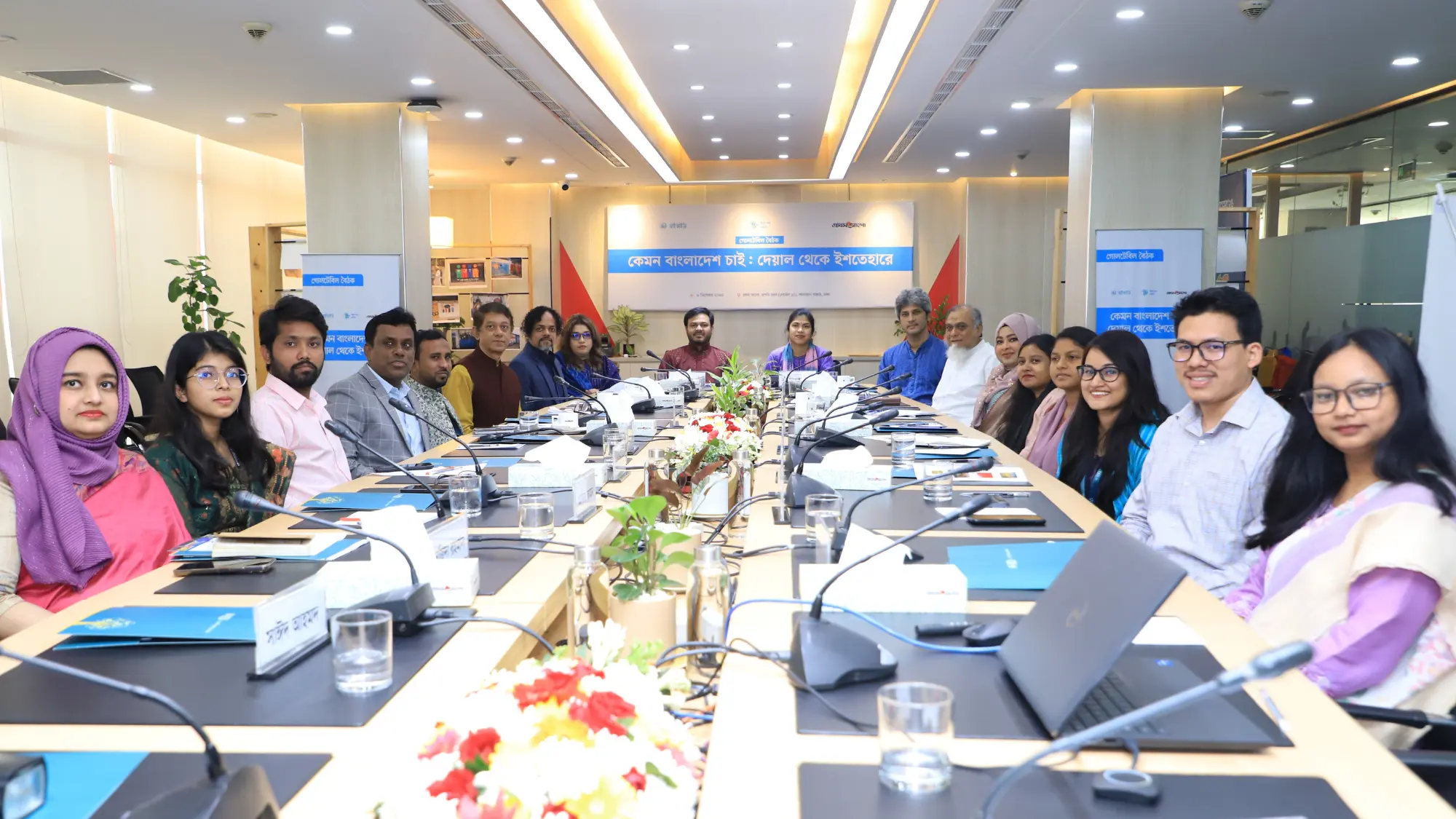
A roundtable dialogue titled “কেমন বাংলাদেশ চাই: দেয়াল থেকে ইশতেহারে” brought together political leaders, youth activists, academics, and civil society representatives to reflect on how the July Movement’s graffiti captured citizens’ aspirations for a discrimination-free Bangladesh. Participants emphasized that the wall writings were not merely protest art, but a bottom-up public expression of demands for dignity, justice, and accountable governance. The discussion urged political parties to meaningfully translate these voices into clear, implementable election manifesto commitments.
Key Voices from the Roundtable
Nazifa Jannat (Co-Vice President, Bangladesh Chhatra Union; Student, East West University)
She reflected on how graffiti evolved from protest slogans to future-oriented visions after July, arguing that Bangladesh needs a clear societal vision grounded in wellbeing, empathy, and social cohesion rather than only economic growth indicators.
Ariful Islam Adeeb (Senior Joint Convener, National Citizen Party – NCP)
He highlighted deep-rooted discrimination across education, employment, and public services, stressing that unequal treatment based on geography and social status fuels unrest. He identified employment security and accountability in state services as core foundations for a new Bangladesh.
Shama Obayed Islam (Organizing Secretary, Central Committee, BNP)
She noted that the July Movement echoed demands for democracy, freedom of expression, and an end to authoritarian practices. Linking the graffiti messages to political reform agendas, she emphasized youth development and inclusion of marginalized communities as essential for national progress.
Junayed Saki (Chief Coordinator, Gonosamhati Andolon)
He cautioned that sustainable change requires aligning values with everyday behavior, warning that oppression can persist socially even among those opposing it. He stressed constitutional recognition, land rights, mother-tongue education, and dignity for the most marginalized as indicators of a humane society.
Saiful Alam Khan (Central Executive Council Member, Bangladesh Jamaat-e-Islami)
He argued that identifying and addressing discrimination must be central to manifesto-making and emphasized anti-corruption as Bangladesh’s most urgent challenge. He also highlighted women’s workplace safety and equal citizenship regardless of religion or region.
Syeed Ahamed (CEO, IID)
He stated that July graffiti collectively formed a public charter against economic, gender, religious, ethnic, and professional discrimination. He urged political parties to reflect these citizen-driven demands clearly in their election manifestos so the anti-discrimination spirit of July is not lost.
- M. Shamim Reza(Professor, Department of Mass Communication & Journalism, University of Dhaka)
He observed that many political actors remain unprepared with forward-looking manifestos and stressed the need to include youth culture, digital and cyber policy, freedom of expression, and media independence as actionable commitments rather than symbolic promises.
Nasrin Sultana (Joint General Secretary, AB Party)
She described the graffiti as a baseline for Bangladesh’s future direction, warning that political forces ignoring these voices risk irrelevance. She emphasized inclusive policies, social security, women’s safety, and skills development to build capable and self-reliant citizens.
Abu Hanif (Member, Higher Council, Gono Odhikar Parishad – GOP)
He questioned whether political parties would genuinely internalize the July Movement’s demands, prioritizing fairness over uniformity. He stressed employment, practical education, entrepreneurship, and cyber safety for women as key manifesto priorities.
Mukta Baroi (Member, Socialist Students’ Front)
She argued that ending discrimination requires structural reform of economic, education, and health systems. She called for state responsibility in universal, secular education and public healthcare, alongside women’s rights, childcare support, cyber security, and inclusive legal reforms.
Sunjida Rahman (Head, Youth for Policy; Senior Joint Director, IID)
She explained that Tarunner Ishtehar is Youth for Policy’s flagship initiative and that the 2025 process is framed as “Wall to Manifesto.” She shared how youth volunteers collected over a thousand graffiti nationwide, identifying patterns of discrimination and proposing policy solutions.
Tamanna Sing Baroik (Tea Community Representative; Project Officer, Dalit Nari Forum)
She highlighted how Dalit, tea-worker, indigenous, and other marginalized communities have faced generational exclusion without adequate data or recognition. She called for skills training, alternative livelihoods, protection for girls, and meaningful representation in policymaking.
Afia Zaman (Volunteer, Youth for Policy)
She described graffiti as a medium for unheard voices, carrying stories of anger, hope, and resistance into public and international view. She emphasized that the wall messages reflect aspirations for dignity, social security, and equal opportunity.
Ruma Roy Mona (Volunteer, Youth for Policy, Dinajpur)
She shared how youth used graffiti to counter rumors and protect minority communities at the local level, stressing that wall messages reach people beyond digital platforms and reinforce commitments to inclusion and safety.
Md. Hamim Islam (Volunteer, Youth for Policy, Khulna)
He emphasized that employment and inequality cannot be addressed without education reform, including teacher quality, depoliticization of education, and adequate budget allocation. He stressed inclusive education for marginalized regions as key to building skilled human resources.
Probin Tripura (Coordinator, Youth for Policy)
He underscored indigenous land rights as central to justice in both hill and plain regions, calling for constitutional recognition, access to education and health services, and long-term protection of indigenous language and culture beyond electoral cycles.
Key Recommendations from the Roundtable
Participants collectively urged that future election manifestos and governance agendas should:
- Commit clearly to building a discrimination-free, inclusive, and just Bangladesh
- Ensure quality, equitable access to education and healthcare across regions
- Strengthen policies for women’s safety, including safe transport and cyber security
- Guarantee equal employment opportunities, safe workplaces, daycare facilities, and maternity protections
- Address corruption through transparency, accountability, and ethical politics
- Institutionalize meaningful youth participation and skills development in national policy
- Protect media freedom and freedom of expression both online and offline
- Safeguard cultural rights and recognize youth as cultural, ethical, and human resources for the nation
See the news on Roundtable Dialogue: